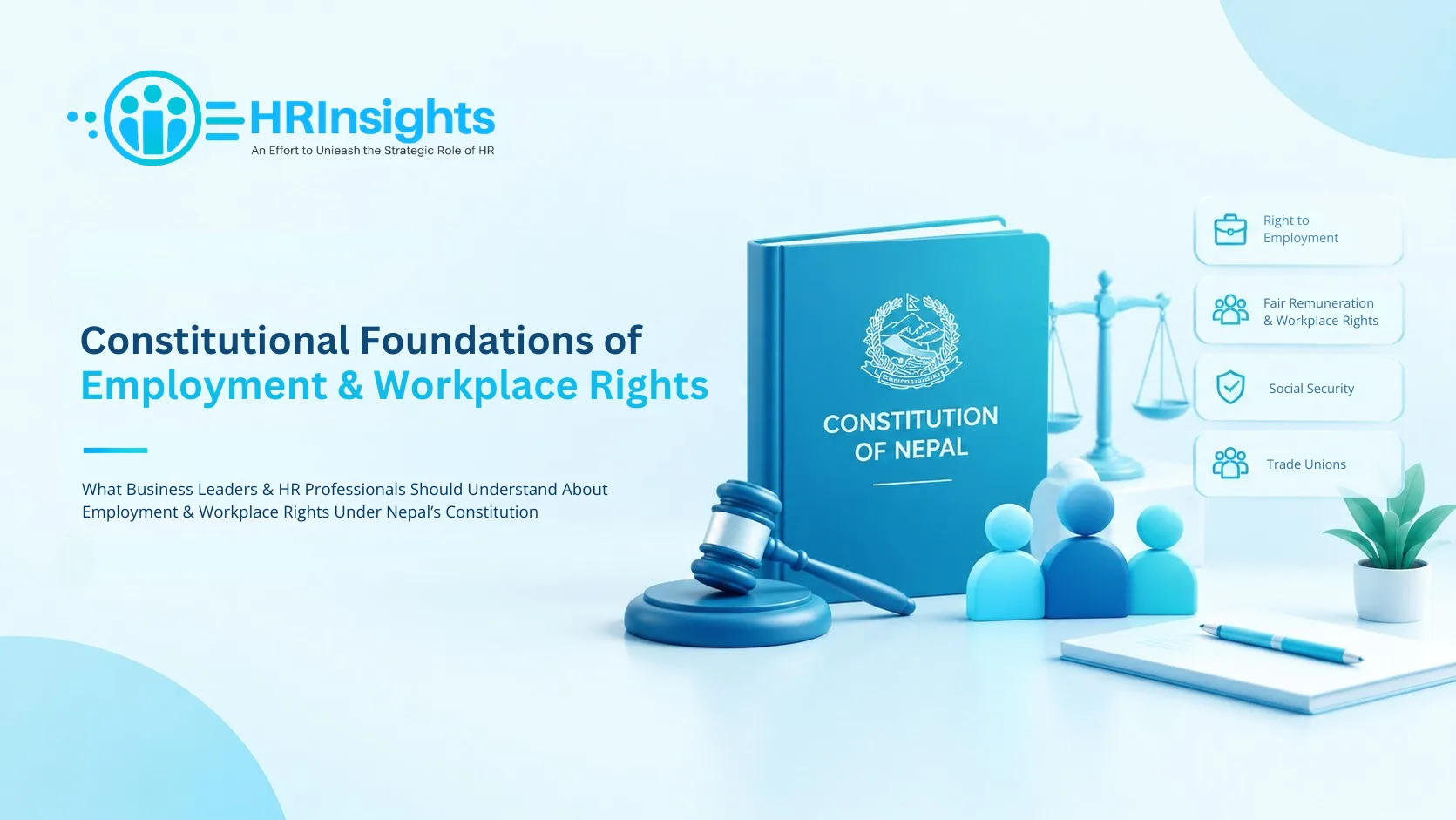
Constitutional Foundations of Employment & Workplace Rights
The Constitution of Nepal establishes fundamental rights governing employment and workplace practices. Key provisions include the Right to Employment (Article 33), Right to Fair Labour, Remuneration, and Contributory Social Security (Article 34), Right to Form Trade Unions (Articles 17 & 34), Equality and Non-Discrimination (Articles 18 & 24), Privacy and Dignity (Articles 16, 28, & 29), and Protection of Women and Children (Articles 38 & 39). These constitutional rights are implemented through specific statutory frameworks, including the Labour Act 2074, Contribution-Based Social Security Act 2074, Right to Employment Act 2075, and Trade Union Act 2049. Compliance requires aligning internal HR policies with statutory and constitutional standards rather than relying solely on internal employment contracts.
DISCLAIMER:
Unofficial translation and educational summary. This publication is intended to reflect the relevant Nepali legislation and regulatory framework, including amendments and materials reviewed up to 1 September 2026. It is not a certified consolidated translation. If the English wording, section reference or summary differs from the official Nepali text or Nepal Gazette, the official Nepali text prevailsEmployment law is often approached through contracts, payroll, leave, working hours, social security and disciplinary procedures. But beneath these operational requirements lies a broader legal foundation: The Constitution of Nepal.
Overview
The Constitution establishes fundamental rights and principles that shape how organizations recruit, employ, manage, compensate and protect people. It does not prescribe every employment procedure or business practice. Instead, these constitutional principles are given practical effect through legislation such as the Labour Act, 2074, Right to Employment Act, 2075, Contribution-Based Social Security Act, 2074, and other applicable laws and regulations.
For business owners, entrepreneurs, leaders and HR professionals, understanding this relationship is important. Employment compliance is not simply an HR responsibility; it is part of responsible business management and organizational governance.
The question, therefore, is not simply:
“What does the Constitution say?”
The more practical question is:
“What does this constitutional right mean for the workplace, which law gives it practical effect, and what should an organization do in response?”
This is where constitutional principles become relevant to everyday business decisions.
The Constitutional Rights That Matter to Business
Right to employment - Article 33
Article 33(1) guarantees every citizen the right to employment, while Article 33(2) guarantees the right to choose employment. The Constitution provides the foundation for these rights, while the detailed conditions of employment and unemployment benefits are governed by federal law.
For businesses, the practical framework comes through legislation such as the Right to Employment Act, 2075 and Labour Act, 2074, which translate constitutional principles into applicable employment rules.
In practice: HR and business leaders should distinguish between the constitutional right and the legal requirements that implement it. Recruitment and employment practices should therefore be aligned with applicable employment law, not based solely on internal policies or employment contracts.
Right to Labour, Remuneration and Facilities — Articles 34(1) and 34(2)
Article 34(1) guarantees every labourer the right to appropriate and fair labour practice, while Article 34(2) provides the right to appropriate remuneration, facilities and contributory social security.
These provisions establish the constitutional foundation for fair treatment, remuneration and social security. The Labour Act, 2074 and other applicable laws give these rights practical effect by setting specific employment standards and obligations.
In practice: HR and business leaders should ensure that employment contracts, policies, compensation practices and workplace arrangements comply with the applicable legal standards and do not undermine constitutionally protected labour rights.
Right to Contributory Social Security — Article 34(2)
Article 34(2) recognizes contributory social security as a constitutional labour right. Its implementation is governed by the Contribution-Based Social Security Act, 2074 and the Social Security Fund (SSF) framework, which establish applicable registration and contribution obligations for employers and workers.
For businesses, social security is therefore an integral part of employment compliance, not simply an employee benefit.
In practice: : Employers should ensure that applicable SSF registration, contribution and related obligations are properly incorporated into employment and payroll processes.
Note: Article 43 provides a separate social-security entitlement for specified vulnerable groups and should not be confused with employment-based contributory social security.
Right to Form and Join Trade Unions — Article 34(3)
Article 34(3) guarantees every labourer the right to form and join trade unions and engage in collective bargaining, in accordance with law. Article 17(2)(d) also protects the general freedom to form unions and associations.
The practical framework is governed by the Trade Union Act, 2049 and the Labour Act, 2074, including provisions relating to trade-union registration, representation and collective bargaining.
In practice: Employers should respect employees’ rights to form and join trade unions, maintain neutrality in union-related matters, and handle recognition and collective-bargaining processes in accordance with applicable law.
Equality and Non-Discrimination — Articles 18 and 24
Article 18 establishes the constitutional guarantee of equality and protection against discrimination, while Article 24 provides specific protection against untouchability and discrimination.These constitutional protections, together with applicable employment legislation, establish a framework for fair and non-discriminatory treatment in employment.
In practice: Employers should apply objective and consistent criteria in recruitment, compensation, promotion and disciplinary decisions, and maintain appropriate records to demonstrate the basis for those decisions.
Privacy, Dignity and Protection Against Exploitation — Articles 16, 28 and 29
Article 16 guarantees the right to live with dignity, Article 28 protects the right to privacy, and Article 29 protects against exploitation, including trafficking, slavery, servitude and forced labour.
These constitutional protections are relevant to employment practices involving employee information, workplace privacy, recruitment, working conditions and third-party labour arrangements.
In practice: Employers should protect employee privacy and dignity, prevent unlawful exploitation or coercion, and maintain appropriate records to demonstrate compliance.
Protection of Women and Children — Articles 38 and 39
Articles 38 and 39 establish broader constitutional protections for women and children, with important implications for employment. Article 38 protects women against violence and exploitation and recognizes special opportunities in employment and social security. Article 39 protects children from exploitation and prohibits their engagement in factories, mines or other similar hazardous work.
These constitutional protections are further given practical effect through legislation including the Labour Act, 2074, Child Labour (Prohibition and Regulation) Act, 2056, Children Act, 2075, and related rules, which establish specific protections, requirements and restrictions.
In practice: Employers should ensure that employment and workplace practices respect applicable protections for women and do not engage children in work prohibited by law.
Employer Should Know
Map HR policies to constitutional equality, dignity and labour-right principles
Use objective recruitment, pay and disciplinary criteria
Protect employee personal information
Do not treat constitutional rights as only public-sector issues
Employee Should Know
Employees should understand which provisions affect their employment, remuneration, benefits, working conditions, records, approvals and remedies. They should retain contracts, payslips, tax/social-security records, approvals and relevant communications.
Common Misunderstanding
MYTH: “If our employment contract and HR policy comply with our internal rules, we are compliant.”
REALITY: Internal policies and employment contracts must operate within the applicable legal framework. Compliance requires considering constitutional protections, employment legislation and other applicable laws—not internal documents alone.
For International Employers Entering Nepal
For international companies entering Nepal, the constitutional principles discussed above form part of the broader legal framework governing their workforce. Establishing a company, obtaining investment approval or securing a business licence does not, by itself, address all employment obligations.
International employers should separately consider applicable labour, social security, immigration, tax, foreign-exchange and sector-specific requirements when hiring or deploying personnel in Nepal. The applicable requirements may also vary depending on the structure through which the workforce is engaged.
Key takeaway: Establishing a business presence in Nepal and establishing a compliant employment arrangement are separate legal considerations.
FAQs
Can an employment contract override constitutional or mandatory employment rights?
No. Employment contracts and workplace policies must operate within the applicable legal framework and cannot remove mandatory legal protections.
Is social security in Nepal a constitutional right or just an employee benefit?
Yes, It is a constitutional right. Article 34(2) recognizes contributory social security as a labour right, and the Contribution-Based Social Security Act, 2074 and the SSF framework set out the registration and contribution obligations that implement it. This makes SSF compliance a legal requirement, not a discretionary perk.
Do constitutional employment rights apply to international companies operating in Nepal?
International employers operating in Nepal should consider the constitutional and statutory employment framework applicable to their workforce, alongside labour, social security, immigration, tax, foreign-exchange and sector-specific requirements.
What should employers in Nepal consider when implementing constitutional employment rights?
Employers should consider applicable employment, social-security, equality, privacy, workplace-protection and other relevant laws when developing contracts, policies and workplace practices.
Join the Conversation
Employment law is not only about knowing what the law says—it is about understanding how legal rights translate into workplace decisions.
Join the HRInsights Community to explore practical employment and workplace issues with HR professionals, business leaders and practitioners.